Never Want to Work in Christian School Ever Again
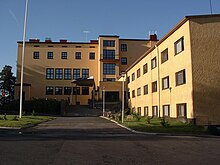
Christian Folk High School of Jämsä in Republic of finland.
A Christian school is a school run on Christian principles or by a Christian organization.[1]
The nature of Christian schools varies enormously from country to country, according to the religious, educational, and political cultures. In some countries, at that place is a strict separation of church and state, so all religious schools are private; in others, in that location is an established church whose teachings form an integral part of the state-operated educational system; in yet others, the state subsidizes religious schools of various denominations.[1]
Background [edit]
Traditionally, many Christian denominations have seen providing catechesis every bit a necessary office of the educational formation of children; the Emmanuel Clan of Churches, a Methodist denomination in the conservative holiness movement teaches, for example:[2]
It is our avowed confidence that the responsibility of molding the hearts and minds of our children is assigned by God primarily to the parents. In social club to properly obey this Biblical injunction, we must provide a guarded Christian education for our children and young people. This may be achieved either by the local church maintaining a Christian solar day schoolhouse or by an association of Christian parents who, through a chosen board, employ Christian teaches that are qualified to educate children spiritually and intellectually in the low-cal of God'due south Word.―Principles of Holy Living, Emmanuel Clan of Churches[ii]
To this end, Christian Churches take established schools around the world.
N America [edit]
United States [edit]
In the Usa, religion is by and large non taught by state-funded educational systems, though schools must permit students wanting to report organized religion to do then every bit an extracurricular activeness, as they would with any other such activity.[1]
Over iv one thousand thousand students, about i child in 12, attend religious schools, nigh of them Christian.[1] [3]
There is groovy diversity in the educational and religious philosophies of these schools, as might be expected from the large number of religious denominations in the United States.[1]
Catholic [edit]
The largest arrangement of Christian education in the The states is operated by the Catholic Church.[1] As of 2011[update], there were 6,841 simple and secondary schools enrolling about 2.2 one thousand thousand students.[four] Most are administered by individual dioceses and parishes.[ane]
Lutheran [edit]
The Lutheran Church building–Missouri Synod (the primary conservative Lutheran denomination in the Us) operates the largest Protestant schoolhouse system in the U.s.. As of 2018[update], the LCMS operated one,127 early babyhood centers and preschools, 778 elementary schools, and 87 high schools. These schools educated more than 200,000 students and are taught by 21,000 teachers. Lutheran schools operated by the LCMS also be in Hong Kong and communist china.[5] The Wisconsin Evangelical Lutheran Synod currently operates 403 early childhood centers, 313 unproblematic schools, and 25 high schools equally of 2018[update].[6]
Episcopal [edit]
The Episcopal Church in the United States of America maintains approximately one,200 schools, of which about fifty are secondary schools[7] and which brainwash about 2% of all students in private schools or 0.22% (115,000 students) of the school population in the United States.[1] [8] Although there are relatively few Episcopal schools, many, such equally the Groton School in Massachusetts and St Paul'due south in New Hampshire, and take played a pregnant part in the development of the American prep school.[9] [ page needed ] Episcopal schools are far more likely to be independent, with little exterior control, than their Roman Cosmic counterparts. Many Episcopal high schools have an almanac tuition well in excess of $xv,000,[x] slightly college the average for non-sectarian private schools and far higher than the boilerplate for non-Roman Cosmic religious schools (approx. $7,100 per annum) and over twice the average for Roman Catholic loftier schools (approx. $vi,000 per annum).[11]
Methodist [edit]
The United Methodist Church building and Allegheny Wesleyan Methodist Connectedness operate parochial schools and colleges throughout the United States.[12] [13]
Conservative Protestant [edit]

Many conservative Protestants in the U.s. reserve the term "Christian schoolhouse" for schools affiliated with conservative Protestant denominations, frequently excluding Cosmic schools in item.[fourteen]
These conservative Protestant schools are privately run, often in conjunction with a church building or a denomination. Parents who desire their children taught co-ordinate to the principles of their church, can choose to send their children to such schools, simply unless the school is subsidized by their church, or is function of a school choice or education voucher program funded by the government, they must pay tuition. Some American Protestant schools are large and well-funded, while others are small and rely on volunteers from the community.[1]
Some Protestant schools, especially those sponsored by fundamentalist groups, do not accept government funding and subsidies because (in their opinion) they would put their school (and potentially their church) operations under more government scrutiny and legislation, which can pb to the regime dictating their schoolhouse's operation (and, possibly, the church's teachings on controversial subjects such every bit abortion or homosexuality). An example of this would be a requirement to adhere to a state's ceremonious rights law, in exchange for the subsidy, this would disharmonize with a Christian school that has mandatory religious requirements for admission, or does not allow its students to opt out of attending religious services. Fifty-fifty though a schoolhouse may take no authorities money, it nonetheless must attach to the country didactics curriculum, student academic functioning standards, and country-mandated standardized testing scores (if whatever). It is also subject to standard inspection by government regulators for in-classroom education quality and teacher qualifications, possibly including visiting classes. Not accepting government coin avoids regime management of a Protestant school, but does not remove governmental oversight.[i]
Co-ordinate to the Seventh-day Adventist Church building, the largest Protestant school system in the world is the Seventh-mean solar day Adventist educational system. The Seventh-day Adventist Church has a total of 6,709 educational institutions operating in over 100 countries around the world with over 1.2 million students worldwide. The N American Sectionalization Office of Education oversees 1,049 schools with 65,000 students in the U.s.a., Canada, and Bermuda.[15] [1]
Another big association of Protestant schools is the Association of Christian Schools International (ACSI). ACSI serves 5,300 fellow member schools in approximately 100 countries with an enrollment of nigh i.2 million students.[1] The American Association of Christian Schools, founded in 1972, brings together many conservative Protestant schools. Members subscribe to a Statement of Faith based on Biblical literalism, creationism, and a rejection of ecumenism.[16] AACS member schools enroll over 100,000 students. The AACS has an active lobbying plan in Washington.
Some other association of Protestant schools is Christian Schools International, with approximately 500 schools and 100,000 students.[1]
One movement among Protestant schools in the U.S. is the return to the traditional subjects and form of education known as classical education. This growing move is known as the Classical Christian Schoolhouse movement, represented past the Association of Classical & Christian Schools, with over 230 schools and colleges, and about 34,000 students.[1]
Mennonites [edit]
Conservative Mennonites, Old Order Mennonites, and Amish groups all operate their ain individual schools and have published their own curriculum since the early on 1960s.
Other [edit]
The Eastern Orthodox Church building and The Church building of Jesus Christ of Latter-day Saints also operate parochial private schools throughout the Usa.[1]
Canada [edit]

In Canada, public funding of religious educational activity is permitted and sometimes required. Many Christian schools in Canada are non-denominational, meaning they're not affiliated with a specific sect of Christianity. Other schools are denominational; they are affiliated with a particular sect. For example, they might be Catholic, Protestant, Orthodox, or follow some other denomination. Amid these, Catholic schools receive the most funding from the government; many of them receive funding for both the secular and religious component of their curriculum.[17]
Historically, Christian schools in Canada were run by private Catholic or Protestant organizations. As public education developed, the majority (usually Protestant) organized religion became represented by the public schoolhouse, and the minority faith (usually Catholic) became represented by a split up school. Over time, the public schools became increasingly secularized every bit Canadian society became increasingly pluralistic.[ commendation needed ]
Most provinces originally had separate school boards in each school district for Catholic and not-Catholic students. Many provinces have abolished this, but Ontario, Alberta, Saskatchewan and the Northwest Territories retain the arrangement. Where this occurs, the two schools are usually chosen the Catholic School Board and the Public School Board.
Many non-Catholic Christians send their children to separate Cosmic schools, preferring their values and standards, despite not practicing the Cosmic faith. Typically, such students are exempt from specific religious instruction classes.[ citation needed ]
The American model is besides used on some private schools, usually run past Protestant denominations.
Public school boards (as distinct from Catholic boards) in Canada normally have no religious affiliation in modernistic times just may still accommodate religious instruction for Christians within their customs. They may do this by creating an individual special purpose Christian schoolhouse, or they may offer religious instruction inside an otherwise secular schoolhouse. This practice has become so prevalent in Alberta that many individual Christian schools accept been absorbed past their local public districts as "alternative Christian programs" inside the public system. They are presently permitted to retain their philosophy, curriculum, and staffing while operating as fully funded public schools. In this regard, they have accomplished some equality with Catholic schools.
These private schools can be associated with a number of unlike organizations. Some are affiliated with the Clan of Christian Schools International, some with Christian Schools International, and some with other organizations. There are also provincial organizations like the Ontario Alliance of Christian Schools a d the Prairie Clan of Christian Schools.
Europe [edit]
U.k. [edit]

The former church building school, Tintagel, Cornwall
In the United Kingdom, church schools are more by and large referred to equally faith schools. In 2012, 33.75% of all maintained schools and 23.thirteen% of all academies in England were faith schools, a total of 6,830 institutions.[18]
The Church building of England was historically a provider of many schools throughout England. Such schools (chosen 'Church of England schools') were partially captivated into the state education system (in the Education Act 1944), with the church retaining an influence on the schools in return for its support in funding and staffing. Such schools are required to accept pupils regardless of religious background, though if they are oversubscribed, they can, and frequently exercise, give preference to applicants of the relevant religion. As of Feb 2017, in that location are 3,731 country schools and 906 academies in England that are church schools.[19] Approximately one quarter of all master schools in England are Church building of England schools and 15 million people alive today went to a Church of England school.[20]

St Aloysius College, Glasgow (RC)
Because of the availability of church-run schools and the tolerance for religious activity in land schools, private Christian schools are a relative rarity, but exercise be throughout the land. Ane of the larger ones, the Liverpool Christian Fellowship Schoolhouse, made national headlines in 2001 when they led a campaign backed past forty other schools, to retain their right to apply caning and other corporal punishments, which was outlawed in 1999. They intended to halt what they felt was a pass up of discipline inside schools.[21] Other Christian schools include Kingsfold Christian School in Lancashire, Carmel Christian School in Bristol, Grangewood Independent Schoolhouse in London, Mannafields Christian School in Edinburgh, Emmanuel Christian School in Leicester, Derby & Walsall, & The River School in Worcester, amidst others.
Kingdom of the netherlands [edit]
In the netherlands the question whether or not public schools should be Christian and in what way was subject field of much argue between 1806 and 1917. During the 2nd half of the 19th century this "School-struggle" reached its tiptop and dominated politics along with voting rights and the district system. In 1917 about of these 3 matters were resolved by the Pacification of 1917. From at present on both confessional (religious) and public schools would become equal funding. Schools grounded in a religious denomination are treated as a type of distinct education (bijzonder onderwijs) and governed past their ain institutions divide from that for mainstream schools.
In the second half of 2006 there were half-dozen,318 Christian schools in the Netherlands; 4,955 primary schools, 1,054 loftier schools and 309 colleges and universities.
Russia [edit]
Russian Orthodoxy is the major class of Christianity practiced in Russia. The Orthodox Church began systemic participation in the elementary teaching field in Russia in 1884 under the "Statute on Church-parish schools". In the post-obit two decades, many privately initiated, illegal "literacy schools" started by peasants were too regularised by placing them nether the control of the Church.[22] Privately founded Orthodox schools not under straight church command played an important role in the spread of Orthodoxy among Russian minorities, prominent examples being the Kazan Cardinal Baptised Tatar School, founded in 1863,[23] or the Simbirsk Central Chovash Schoolhouse, founded in 1868.[24]
There are besides Protestant-associated schools aimed at the children of expatriates, such as the International Academy of St. Petersburg, Russia, founded in 1993.
Oceania [edit]
Commonwealth of australia [edit]
Parochial schools (Church schools) were established in Australia past both Roman Catholic and Protestant churches during the 19th century. Many of these schools, many of which with long traditions, continue to form the bulk of the private or contained school sector in Australia.
The modern Protestant Christian school movement began in Commonwealth of australia through the efforts of Dutch migrants who had enjoyed Christian schools for many decades in their home country.[25] Most belonged to one of the Australian reformed churches of Dutch origin (the Christian Reformed Churches of Australia or the Costless Reformed Churches of Australia, sometimes incorrectly called the Dutch Reformed Church building, which is a name used in the Netherlands, South Africa and Sri Lanka only never in the Australian context). During the 1950s these migrants founded associations of parents who wanted to start Christian schools,[26] and the showtime schools opened, at first without whatsoever government assistance, in the tardily 1950s and early 1960s.
The Gratuitous Reformed Church started the John Calvin Schoolhouse at Armadale, Western Australia which opened its doors on 2 December 1957 with 70 students. It was followed by schools in Albany, Western Australia (1962) and Launceston, Tasmania (1965). The Reformed Churches of Australia (which added 'Christian' to the showtime of their name only in the 1990s) opened their outset school at Kingston, Tasmania in 1962.[27] Their start schools were affiliated with a national body known at that time every bit the National Union of Christian Parent-Controlled Schools,[28] which afterward became Christian Parent Controlled Schools Ltd. (CPCS), and in 2008 was again renamed to become Christian Pedagogy National.
Whereas the Complimentary Reformed schools enrolled simply students from that particular denomination, the Reformed Church-initiated schools were operated past associations of parents who individually belonged to a diversity of Protestant churches and who worked collectively for their mutual aim. These schools were established not because of innate dissatisfaction with government schools, but because these parents wanted schools which would actively integrate their Christian faith into the whole school curriculum. The schools were operated by parent bodies autonomously from supervision of churches.
From the late 1970s, Christians from many other churches became increasingly concerned near standards and social change in government schools and started establishing Christian schools to provide an culling education option.[29] In this phase, many such schools were commenced non by parent associations but by churches themselves, although several parent groups from exterior the Reformed Churches studied and adopted the parent-controlled model and take commenced schools which, while they take no Dutch or Reformed Church connections, take still affiliated themselves nationally with many schools which practise.
The leading umbrella organizations include Anglican Schools Australia, Christian Schools Australia,[30] Lutheran Education Australia (LEA),[31] Christian Education National (formerly Christian Parent Controlled Schools Ltd),[32] and the Australian Association of Christian Schools.[33] This last trunk mainly functions as a political advisory and antechamber grouping for Christian Educational activity National too as a number of Christian schools who are members independently.
Africa [edit]

In many parts of Africa Christian missionary organisations have founded schools, often in places where no other schooling is available. Such schools by and large provide a complete education in a Christian context. In Nigeria, Living Faith Church Worldwide has established several educational institutions, including Covenant University,[34] Landmark University[35] and Faith University.[36]
A Pew Heart report about religion and didactics around the world in 2016, constitute that "there is a large and pervasive gap in educational attainment between Muslims and Christians in sub-Saharan Africa" as Muslim adults in this region are far less educated than their Christian counterparts,[37] with scholars suggesting that this gap is due to the educational facilities that were created by Christian missionaries during the colonial era for fellow believers.[37]
Asia [edit]
Israel [edit]

Latin patriarchal school in Reineh.
According to the study "Are Christian Arabs the New Israeli Jews? Reflections on the Educational Level of Arab Christians in State of israel" past Hanna David from the Academy of Tel Aviv, one of the factors why Arab Christians are the virtually educated segment of Israel's population is the loftier level of the Christian educational institutions. Christian schools in Israel are among the best schools in the state, and while those schools represent only 4% of the Arab schooling sector, about 34% of Arab university students come from Christian schools,[38] and about 87% of the Israeli Arabs in the loftier tech sector have been educated in Christian schools.[39] [xl]
Pakistan [edit]
During the British Raj, a number of Christian Schools were established in the area comprising today'southward Pakistan.
Associations [edit]
- American Clan of Christian Schools
- Association of Christian Schools International
- Clan of Classical Christian Schools
- Christian Schools International
- National Association of Academy-Model Schools
- Nazarene International Education Association
- Ontario Brotherhood of Christian Schools
Meet also [edit]
- Charter school
- Homeschooling
Bibliography [edit]
- Hein, David. "Christianity and Accolade." The Living Church, August 18, 2013, pp. eight–ten.
References [edit]
- ^ a b c d e f g h i j k 50 m northward o "Christian School". K12 Academics. K12Academics. half-dozen February 2014. Retrieved five Apr 2020.
- ^ a b Guidebook of the Emmanuel Association of Churches. Logansport: Emmanuel Association. 2002. p. 15.
- ^ Jacoby, Jeff (nine May 2004). "Making the case for parochial schools". The Boston Globe.
- ^ McDonald, D.; Schultz, Chiliad. (2012), Catholic Schools Statistics And Background: 2011-2012 (statistical reprint), United States Conference of Catholic Bishops, usccb.org, retrieved nineteen January 2013
- ^ "Lutheran Schoolhouse Statistics 2017-2018 School Year". Lutheran Church–Missouri Synod. Retrieved August 13, 2018.
- ^ "WELS Numbers". Wisconsin Evangelical Lutheran Synod. Retrieved August 13, 2018Z.
- ^ Facts & Figures, National Association of Episcopal Schools, episcopalschools.org, retrieved 19 January 2013
- ^ National Center for Education Statistics, Facts and Studies, Quango for American Private Instruction, tabular array "Where do private schoolhouse students go to school?", retrieved 19 January 2013
- ^ Peter W. Cookson, Jr.; Caroline Persell (1985). Preparing for ability. Basic Books. ISBN0-465-06269-five. OCLC 660054698. OL 18166618W. Wikidata Q108671720.
- ^ Come across Groton School, St. Paul'south School (Hold, New Hampshire) and manufactures for TMI — The Episcopal School of Texas, St. Stephen's Episcopal School (Austin, Texas) and St. Andrew'southward Episcopal Schoolhouse (Texas)
- ^ National Center for Instruction Statistics, Facts and Studies, Council for American Private Teaching, table "Average Private School Tuition: 2007-08", retrieved 19 January 2013
- ^ Kostlevy, William (1 April 2010). The A to Z of the Holiness Motility. Scarecrow Press. p. 3. ISBN9781461731801.
- ^ "National Association of Schools & Colleges of The United Methodist Church (NASCUMC)". General Lath of Higher Teaching and Ministry building. Retrieved 13 August 2018.
- ^ David Sikkink, "Diversity in Christian Schools", Education Adjacent, Summer 2001.
- ^ "Adventist Education". Nadeducation.org. 2013-02-18. Retrieved 2016-08-27 .
- ^ Schools, American Clan of Christian. "Statement of Organized religion - American Association of Christian Schools".
- ^ "Guide to Christian Education in Canada". Our Kids Media.
- ^ "Maintained organized religion schools". Department for Education. 26 Apr 2012. Retrieved viii April 2017.
- ^ "Types of Church School". Church of England. 2017. Retrieved 8 April 2017.
- ^ "Church Schools and Academies Information". Church of England. 2017. Retrieved viii Apr 2017.
- ^ Combe, Victoria (2 Nov 2001). "Forty private schools ask judges to back caning". The Telegraph.
- ^ Dowler, Wayne (2001). Classroom and empire: the politics of schooling Russian federation's Eastern nationalities, 1860-1917. McGill-Queen's Press - MQUP. pp. 6–7. ISBN978-0-7735-2099-eight.
- ^ Dowler 2001, p. 101
- ^ Dowler 2001, p. 110
- ^ Deenick (ed.), J. (1991): A Church En Road: twoscore Years Reformed Churches of Australia, Reformed Churches Publishing: 240. ISBN 978-0-9590727-seven-8
- ^ A Church building En Road: 240-1
- ^ A Church En Route: 243
- ^ A Church En Route: 244
- ^ A Church En Route: 249
- ^ "Welcome - Christian Schools Australia". Csa.edu.au . Retrieved 2016-08-27 .
- ^ "Archived copy". Archived from the original on 2009-09-ten. Retrieved 2009-09-ten .
{{cite spider web}}: CS1 maint: archived copy equally championship (link) - ^ "Home". Cen.edu.au . Retrieved 2016-08-27 .
- ^ "Home". Aacs.net.au . Retrieved 2016-08-27 .
- ^ "C.U | David Oyedepo Ministries International". 2012-05-02. Archived from the original on 2012-05-02. Retrieved 2019-12-sixteen .
- ^ "Landmark University | Abode". lmu.edu.ng . Retrieved 2019-12-16 .
- ^ "Organized religion Academy | David Oyedepo Ministries International". 2012-04-29. Archived from the original on 2012-04-29. Retrieved 2019-12-xvi .
- ^ a b "Religion and Education Effectually the World" (PDF). Pew Research Center. December xix, 2011. Retrieved 13 December 2016.
- ^ "Sit-in of Christian Schools in Jerusalem - Holy Land Christian Ecumenical Foundation". Hcef.org. 10 September 2015. Retrieved v September 2016.
- ^ "With schools starved of funds, Christians question their futurity in Israel". Middleeasteye.net . Retrieved 5 September 2016.
- ^ "Why Angry Christians in Israel Are Crying Discrimination - Features". Haaretz . Retrieved v September 2016.
External links [edit]
- Christian College Consortium
- Council for Christian Colleges & Universities
- Private Biblical Homeschooling
- Biblical Life Establish
Source: https://en.wikipedia.org/wiki/Christian_school
0 Response to "Never Want to Work in Christian School Ever Again"
Post a Comment